
This is the graph from Community Speedwatch – Benchmarks of success which tells it all. Speeds did not decrease.
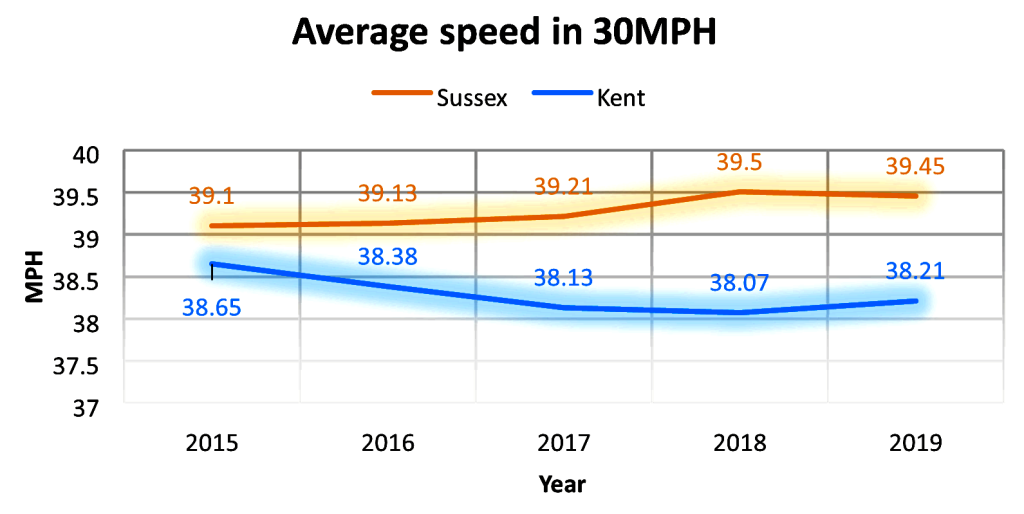
Community Speedwatch has good intentions, but the evidence clearly shows it will not deliver the necessary results for our village.
Several potential Wedmore Speedwatch volunteers looked at the Sussex and Kent 2015-2019 data. They all said “If that’s the outcome, I’m not doing it”.
In summary, a lot of time from dedicated local volunteers would go into Community Speedwatch but it would only have a minor effect in reducing speed, and would certainly not get speeds closer to the safe figure of 20mph and thereby protect the lives of our children and elderly parishioners. It would just serve to distract from the ultimate goal of a 20mph limit.
And that is a matter of life and death.
I think the Parish Council seem to have got themselves a bit confused. The two functions, introducing a Community Speedwatch Programme (CSW) and reducing the speed limit to 20mph are not mutually exclusive.
The focus of CSW is to attempt to get drivers to adhere to the speed limit, and in effect reduce Killed and Seriously Injured (KSI’s) collisions. I have discussed this with the police, and the opinion is that volunteers have approximately 20 effective minutes before drivers are aware of their presence, most likely, due to other drivers flashing their lights as a warning, which, by the way, is illegal.
The Police suggest that the use of mobile speed detection is the best approach believing that not knowing where the Traffic officer will be creates “the fear of being caught”. Does the CSW instil drivers with a fear of being caught? Sadly, I think not.
If the goal is to reduce KSI’s is the CSW effective? In my opinion there is little evidence to suggest it is. It is “toothless”, with no power to issue points or fines. The result of catching a driver exceeding the speed limit results in the offender receiving a police letter. (I attended a Road Safety forum held by the Police and Crime Commissioner. It included the Chief Constable and many other interested parties. The CSW was represented and it became clear that letters were being delayed due to lack of resource.)
By contrast there is significant evidence that reducing the speed limit to 20mph lives are saved.
Various bodies, including the Government, issue statistics regarding survival rates for pedestrians involved in a collision with a vehicle.
• at 40 mph there is a 90 percent chance they will be killed.
• at 35 mph there is a 50 percent chance they will be killed.
• at 30 mph there is a 20 percent chance they will be killed.
• at 20 mph there is a 2.5 percent chance they will be killed.
The difference in survival rates between 30mph and 20mph clearly speaks for itself.
Wedmore has many parked vehicles and narrow pavements, if any. I draw your attention to a statement on the BRAKE web site:
“A vehicle travelling at 20mph would stop in time to avoid a child running out three car-lengths in front. The same vehicle travelling at 25mph would not be able to stop in time, and would hit the child at 18mph. This is roughly the same impact as a child falling from an upstairs window.” Source: https://www.brake.org.uk/get-involved/take-action/mybrake/knowledge-centre/speed/speed-and-injury
Why would you not want to be proactive? Just put yourself in the position of someone who has had their family devastated by a collision, at 30mph, resulting in a KSI. I would not want that on my conscience knowing I could have done something that just might have changed the outcome. Don’t wait for the knock on your door.
I looked into the introduction of a CSW in Blackford on the B3139, had discussions with the Police. In the end I decided that CSW did little to provide a safe environment and reduce KSI’s. However well-meaning it is just a tick box, a sticking plaster for an amputation.
Finally Manchester Fire Service have a website that addresses the issue of speed https://manchesterfire.gov.uk/your-safety/road-safety/all-drivers/fatal-4/speed/
I have downloaded the presentation here are quotes from page 9 and 10, I feel are relevant:
Page 9
Slower Driving is Safer
• The faster a vehicle is travelling, the longer it takes to stop.
• The faster we drive, the greater our risk of crashing. A crash at 30mph has twice the energy and destructive potential of a crash at 20mph.
• The greater the impact speed, the greater the chance of death.
• Where traffic is slow, more people choose to walk or cycle. 20mph is an appropriate maximum speed in places where people live.
Page 10
Speeding Drivers Expect To Be caught
• Investment in roads policing and a comprehensive speed enforcement programme is essential to catch speeding drivers and deter people from speeding.